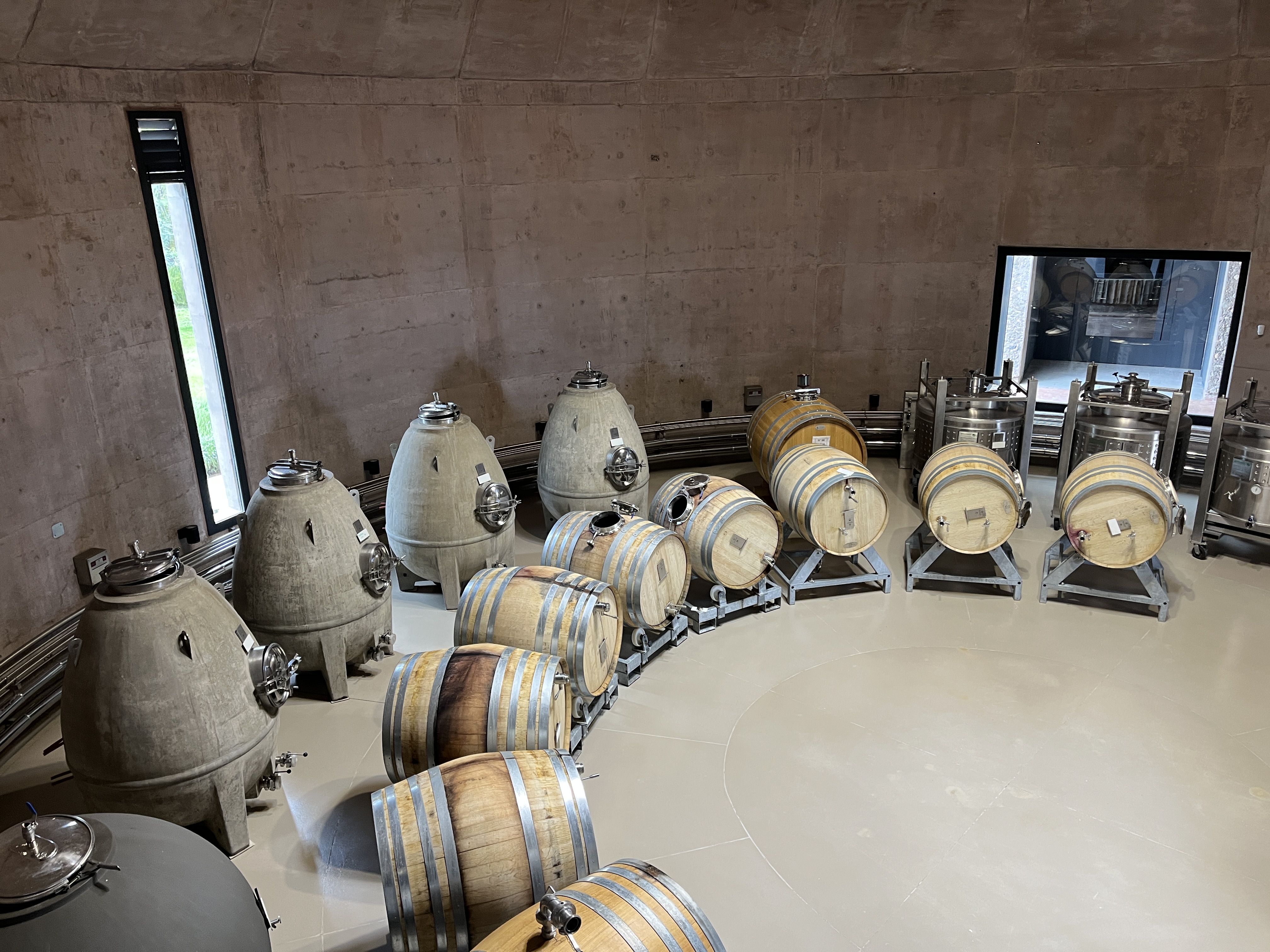
Walk into almost any winery and eventually you’ll find yourself looking at barrels. They’re beautiful. They’re atmospheric. They make fantastic winery photos.
And they’re only one of the ways wine can spend the months – or years – before bottling. Winemakers have several options for aging wine, and the vessel they choose can influence what eventually ends up in your glass.


Stainless steel: keep it fresh

Stainless-steel tanks don’t add flavor to wine. Stainless-steel tanks don’t add flavor to wine. They’re neutral and allow winemakers to limit oxygen exposure and carefully control conditions during aging. That makes stainless particularly useful when the goal is preserving freshness, fruit and bright acidity.
Think Sauvignon Blanc, Pinot Grigio or a crisp Chardonnay. Of course, plenty of other wines see stainless steel too, but those are ones that we commonly find aged in stainless.
Concrete: the option you’re seeing more often
If you’ve toured wineries recently, you may have encountered enormous concrete tanks – or those wonderfully photogenic egg-shaped vessels that seem to be popping up in wineries everywhere.
Concrete offers winemakers something of a middle ground. Like stainless steel, it doesn’t contribute the obvious flavors we associate with new oak. But unlike stainless steel, concrete is slightly porous, allowing very small amounts of oxygen to interact with the wine as it develops. That slow oxygen exposure can help soften and develop the wine without adding oak flavors.
Concrete is also excellent at maintaining a relatively stable temperature – useful when you’ve got wine quietly developing for months.
And what about those eggs?
Concrete doesn’t have to be egg-shaped, but the curved shape of a concrete egg can encourage the wine to circulate naturally inside the vessel. That movement can help keep the lees suspended in the wine (we’ll talk about lees a little later in this article), potentially adding texture without requiring as much stirring.
So, yes, the concrete egg looks very cool in a winery photo. But there’s actually a good reason for that unusual shape.

And then there are amphorae
Long before anyone had stainless-steel tanks – or French oak barrels, for that matter – people were making and storing wine in clay vessels.
Today, you’ll once again see amphorae in some modern wineries. These vessels are generally made from clay or terracotta and come in a variety of shapes and sizes. Depending on how they’re made and lined, they can allow some oxygen interaction while generally avoiding the flavors associated with oak.
That gives winemakers another way to let a wine develop while keeping the focus largely on the fruit itself.
And while amphora may seem like one of the newest trends in the wine world, it’s actually one of the oldest. Versions of clay wine vessels have been used for thousands of years – particularly in places like Georgia (the country – not the state!), where traditional qvevri winemaking continues today.
So if you walk into a winery and spot what looks like a giant clay pot tucked among the tanks and barrels, it’s probably not cellar décor. It may be holding the wine you’re about to taste.
An amphora gives winemakers another way to let a wine develop while keeping the focus largely on the fruit itself.
And while amphora may seem like one of the newest trends in the wine world, it’s actually one of the oldest. Versions of clay wine vessels have been used for thousands of years – particularly in places like Georgia (the country – not the state!), where traditional qvevri winemaking continues today.

So if you walk into a winery and spot what looks like a giant clay pot tucked among the tanks and barrels, it’s probably not cellar décor. It may be holding the wine you’re about to taste.
And then there’s oak
Oak does two important things. It allows a very small amount of oxygen to interact with the wine over time, and it can also contribute flavors and aromas.
Depending on the barrel and how it’s used, you might notice things like: vanilla, baking spice, toast, cedar, smoke or coconut. But “oaked” doesn’t automatically mean you’ll taste a mouthful of lumber.
Size matters, too. A smaller barrel exposes more of the wine to oak relative to its volume, while larger oak vessels generally have a subtler influence.
Sip Savvy
Clues a Wine May Have Been Aged in Oak
Ever notice vanilla, baking spice, toast, cedar, smoke or coconut in your wine? Those aromas can be clues that the wine spent time in oak.
New oak tends to have the greatest influence because the barrel has never been used. With each use, a barrel contributes less oak character, which is why winemakers may use a combination of new and older barrels when they want the benefits of barrel aging without pronounced oak flavors.


Not all barrels are the same
This is where things get fun.
French oak isn’t the same as American oak. French and American oak can contribute different characteristics, too. American oak is often associated with more pronounced vanilla, coconut and sweet spice notes, while French oak is often described as having a subtler, spicier influence.
And a brand-new barrel has much more influence on wine than a barrel that’s already held wine for several years. Barrels can have different levels of toast. And a winemaker might age only part of a wine in new oak while the rest goes into older barrels.
So when you hear: “18 months in French oak, 30% new”, you can translate it roughly as: The wine spent a year and a half in French oak barrels, but only about a third of those barrels were new enough to have a stronger influence.
That’s probably all most of us need to know.
What about “lees”?
Here’s another term you may hear, particularly with white wine and sparkling wine.
Lees are primarily the spent yeast cells left behind after fermentation. Rather than immediately separating the wine from them, a winemaker may choose to let the wine age on the lees. This can add texture and complexity — sometimes contributing a creamier mouthfeel or bread-like, yeasty notes, particularly in certain white and sparkling wines. And sometimes the lees are periodically stirred — bâtonnage, if you’d like a fun French wine word to casually drop at your next tasting.
But the takeaway is simpler: The time between fermentation and bottling isn’t just waiting. Wine is still developing, and the winemaker is still shaping it. If you’ve been following along, this has exposed yet another series of decisions the winemaker makes in order to produce the wine. Each small decision can deliver big impact on the final pour.
If you’ve been following along with Behind the Bottle, you’ve probably noticed a theme by now: winemaking is one decision after another. Stainless or concrete? New oak or neutral oak? How long should the wine age? Should it stay on the lees?
Each decision may seem small, but together they help shape what eventually ends up in our glass. We find the whole process fascinating! We hope you have been, too.
Next in Behind the Bottle: Blending, bottling and finally getting that beautiful wine into our glasses.