
Wine Travel · A Visit from Our Travels
We knew Smith-Madrone Winery wasn’t going to be a typical Napa tasting experience. Perched high on Spring Mountain, this family-owned winery has been growing grapes and making wine since 1971, with little interest in the polished tasting rooms and elaborate hospitality found elsewhere in the valley. That was exactly what drew us there. We wanted to meet the people behind the wines, explore the rugged mountain vineyards, and taste what more than fifty years of hands-on winemaking could produce. What we didn’t anticipate was navigating a white-knuckle drive up the mountain, tasting exceptional wines with Charlie Smith himself, and finding ourselves in the middle of harvest, with Cabernet Franc fermenting just a few feet away.
At a glance
LocationSpring Mountain District, St. Helena, Napa Valley, California
EstateFamily-owned since 1971; approximately 200 acres of mountain property, with about 34 acres planted to vines
The winesDry Riesling, Chardonnay, Rosé, Cabernet Franc, Cabernet Sauvignon, and Cook’s Flat Reserve
Our experienceA small-group tasting led by Charlie Smith in the working barn during harvest, plus a walk to a vineyard overlook
Arriving at the Winery
The visit starts with the drive. We headed to Smith-Madrone from Calistoga, and despite the directions explicitly provided in our confirmation, we decided to take what looked like a more scenic route.
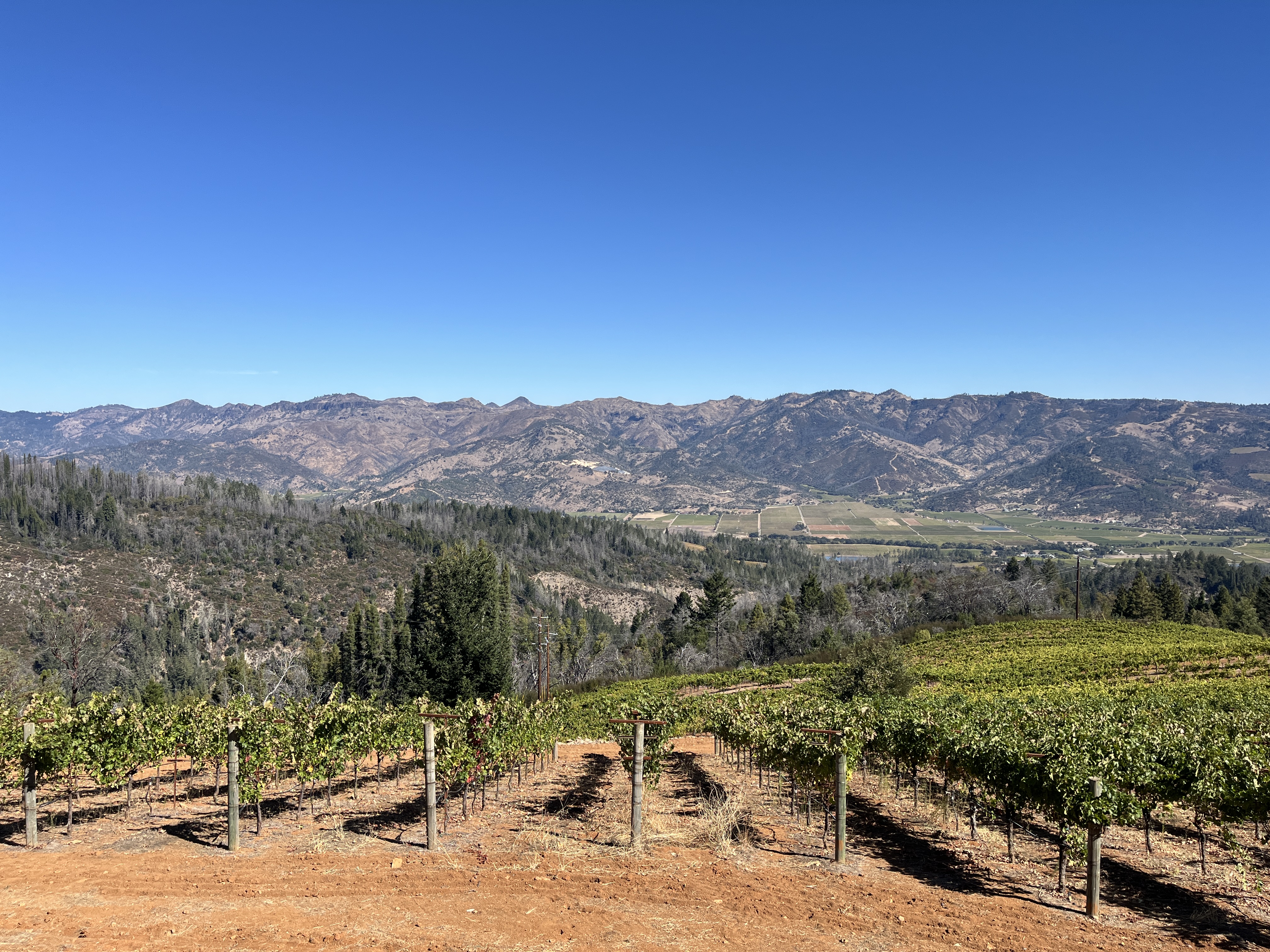
Rather than approaching from St. Helena via Spring Mountain Road, we headed west out of Calistoga along Petrified Forest Road, eventually winding our way up St. Helena Road and past Pride Mountain Vineyards. It’s a beautiful drive, but not one for the faint of heart. The road twists and narrows as it climbs through dense forest, with steep hillsides and sharp turns that demand your attention. By the time we reached Smith-Madrone, the valley floor felt a world away. The vineyards sit between roughly 1,300 and 2,000 feet, with some slopes reaching a remarkable 34 percent. Red earth and broken stone show between the rows, while Douglas fir, oak, redwood, and madrone surround the vineyards. It’s rugged, dramatic terrain, and far more than a beautiful backdrop. It’s an essential part of what makes Smith-Madrone’s wines so distinctive.


A Historic Estate on Spring Mountain
Smith-Madrone began in May 1971, when 22-year-old Stuart Smith bought 200 forested acres on a remote stretch of Spring Mountain. Old grape stakes showed that somebody had planted vines here in the 1880s, before Prohibition helped end the first chapter, but that was about the only trace of vineyards when they arrived. The paper trail goes back to George W. Cook, who received title from the U.S. Land Office in 1884 and planted grapes. Stuart and his partners cleared what they needed, kept the madrone trees and an old corridor of olive trees, and planted Chardonnay, Riesling, Cabernet Sauvignon, and Pinot Noir in 1972. Today, about 34 vineyard acres sit inside the surrounding forest. The name is simple: Smith for the family, Madrone for the trees.
Sip Savvy
What is a Madrone Tree?
A madrone is a broadleaf evergreen native to the West Coast and common in Northern California’s mountain forests. It is easy to recognize once you know what to look for: smooth, cinnamon-red bark that peels away in thin sheets, glossy dark-green leaves, white bell-shaped flowers in spring, and red berries in fall. It often grows with a twisting, irregular shape on dry, rocky, well-drained ground.
While Stuart, who is better known as Stu, began the winery, his brother Charlie joined him shortly after in 1973 as the winemaker, although he had been involved on a more part time basis since the beginning. He’s been known to claim that winemaking was just a hobby that got out of control. (We may think that enjoying wine was a hobby that just got out of control for us, too!)
Inside the Winery
So when we finally arrived at the winery, we met up with a small group of other wine lovers for our shared tasting.
We were relieved to have made it (there may have been a few white knuckles on the ride up the mountain) and were thrilled to learn that the visit would be led by Charlie Smith, himself, who we met just outside the barn, where the harvest was actively taking place.
As we began the visit, Charlie led us first into the working barn. Charlie focuses on the winemaking side of the business, while his brother, Stu is the viticulturalist. And the barn was definitely Charlie’s domain. Heavy timbers, plank walls, exposed rafters, shelves, tools, barrels, and winery equipment surrounded us as glasses were poured and passed around. No assigned seats. No choreographed procession. We gathered where there was room, listened as he spoke, asked questions, tasted, and moved from one beautiful wine to the next. The format kept everyone engaged and kept the conversation honest. Nothing had been cleared away to create an “experience.” The room was part cellar, part workshop, and part family headquarters. There was an open vessel of Cab Franc fermenting right behind us. Charlie belonged in it. So did the wine.

And while we sipped, learned, and talked, harvest was moving around us. Freshly picked clusters of Merlot sat in bins. Grapes were being sorted and processed. Hoses crossed the floor. Tanks and open vessels were in use. The tools were stained because they had work to do. Fruit from the slopes outside was becoming wine only a few steps from us. We were tasting finished vintages while the next one was getting started. That made the whole visit snap into focus.
The group’s reactions needed no translation. A first sip of the wine brought raised eyebrows, quick looks across the circle, broad smiles, and the occasional quiet pause before someone went back to the glass. Nobody had to announce that the wines were excellent. The faces around the barn had already done the job.
The group format never got in the way of personal attention. Charlie worked the circle, answered follow-up questions, and made room for direct exchanges without turning the tasting into a seminar. We could ask about a wine, a barrel choice, a vintage, or the property and get an answer from the man who had done the work. That access was rare, and we knew it.


That hands-on scene was no performance. Charlie and Stu built the winery with stone and lumber from the property. French and American barrels fill the cellar and main floor. Their methods draw from French, German, and California practice: barrel fermentation, aging on the lees, and open-top fermentation. All of it takes labor. During harvest, there is nowhere for lazy thinking – or lazy hands – to hide.
Mountain Farming, by Exposure


Partway through the tasting, we stepped out of the barn and walked with Charlie to a lookout above the vineyard. The break gave us a wider view of the property and a chance to talk. The lookout put the whole place in order. Vineyard blocks broke across the slopes at different angles, hemmed in by forest and divided by terrain that looked demanding from the road and even steeper from the overlook. We could look down into St Helena and out across the valley. The view and the landscape were beautiful, but it was not gentle. Near the lookout, an orderly lawn and traces of earlier barbecues suggested another side of the property: a place where the Smith family could gather around a long table, eat well, and look out over the land they had spent decades working. Spring Mountain was no longer a name on the label. We were standing in it.

On our return to the barn, we had a chance to ask Charlie about wine, the work, and his family. He shared stories that gave us a glimpse of the person behind the wines, and some are best left for him to tell. That conversation made our walk through the vineyards one of the highlights of the day…and of our entire Napa trip.
We learned that Stu planted the vines by exposure, not convenience. Riesling went on the eastern slopes. Cabernet Sauvignon took the warmer southern and western ground. Chardonnay went north, where it stays cooler. The cut banks in the previous images show what the vines are dealing with: deep-red Aiken Stoney Clay loam packed with rock.
Aiken Stoney Clay is deep-red, rocky volcanic soil that drains well and forces the roots to search for water. Combined with the cooler mountain temperatures and careful vineyard placement, it’s part of what gives Smith-Madrone’s wines their structure, acidity, and distinctive character.
The People Behind Smith-Madrone
Along with Stu and Charlie, François Bugué is the associate winemaker. We had the chance to see him in action, and meet him during our visit. (And if you’ve taken any courses at Napa Valley Wine Academy the name Catherine Bugué may ring a bell as one of its founders – and also François’ wife).
More than fifty years after the first planting, the brothers remain in the vineyard, the cellar, and make the daily decisions. Stuart may lean toward the vines and Charlie toward the wine, but neither is watching from an office somewhere else.
Charlie loves wine, and he has no interest in pretending otherwise. On the table in the barn next to award ribbons and stories about the winery were bottles from well-regarded wineries from around the world. He guided our tasting party from farming to barrels, aromas, fermentation, age, and pleasure without turning any of it into a lecture.
His opinions were firm, funny, and occasionally blunt. We like his approach. Wine has suffered enough from people speaking about it as if they were applying for membership in a private club. Charlie spoke like a man who has made it, tasted it, argued about it, and gone back to work the next morning. With harvest moving outside the barn, his enthusiasm had even more weight behind it.
We had heard about the brothers before we reached the mountain. At other wineries, people told us how Charlie and Stuart had worked to defend the property when fires swept through the area. They were protecting the winery, the land, and the wines they had spent a lifetime building. These were not publicity stories. They came from people in the valley who understood the danger and respected the brothers for meeting it head-on. The wines have earned respect. So have the men who make them.
Tasting Notes: Riesling to Reserve Cabernet
The tasting moved from dry Riesling and barrel-fermented Chardonnay through rosé, Cabernet Franc, Cabernet Sauvignon, and the 2018 Cook’s Flat Reserve. Different grapes, same backbone: acidity, structure, and mountain character. Every wine came from the estate and carried the Spring Mountain District appellation. The lineup did not need a theme imposed on it. The place was the theme.
2021 Riesling — Dry and Alsatian in style. Petrol on the nose, then stone fruit and apple. The acidity was clean and firm. This wine is built to age, but it was already clear, focused, and very easy to respect.
2021 Chardonnay — Charlie believes Chardonnay belongs in a barrel, so that is where this one went. Tropical fruit and flowers came first. Roughly 50 to 60 percent new oak added shape without smothering the wine, and the lack of malolactic fermentation kept it bright. Rich enough to hold attention. Fresh enough to finish the glass.
Charlie supplied the useful arithmetic: a new barrel costs about $1,400. Romance has an invoice.
He was just as direct about Sauvignon Blanc, offering a description of its aroma that no tasting-room script would survive. We will leave the exact phrase in the barn. The point was clear: this was a conversation, not a presentation.
2025 Rosé of Cabernet Franc and Merlot — Rhubarb and strawberry, made by the saignée method with roughly 10 to 15 percent of the juice bled off for concentration and color. Dry, lightly tannic, and more substantial than its color suggested.
2023 Cabernet Franc — From vines planted more than 30 years ago; 90% Cabernet Franc and 10% Cabernet Sauvignon. Plum, tight structure, and a finish that refused to leave. This was the wine that stopped the group. No hedging required. Mind blown!
2022 Cabernet Sauvignon — Tannic, but matched by firm acidity and moderate alcohol. The structure points to a long life. The familiar Cabernet notes were all there, but the balance mattered more than a checklist of aromas.
2018 Cook’s Flat Reserve — 87% Cabernet Sauvignon and 13% Cabernet Franc. Dark fruit and cassis came through clearly, with deep ruby moving toward garnet and the first signs of bottle age. The finish was long and savory. Complex, yes, but not complicated for the sake of it. Cook’s Flat is the eight-acre plateau-like block named for George Cook, the property’s first recorded owner. The wine is made only when the vintage earns it, in tiny quantities. Each bottle is numbered and wrapped in a reproduction of Cook’s original U.S. Land Office patent. History, properly used.
Why We Loved Smith-Madrone
We loved Smith-Madrone because nothing felt manufactured. The road is steep. The soil is red and full of rock. The vines are dry-farmed. The barn is a workplace. Harvest does not stop because visitors arrive. Stuart and Charlie have spent more than fifty years building, farming, fixing, tasting, and arguing their way toward wines they believe in – and they are still there doing it.
The Riesling and Chardonnay had nerve. The Cabernet Franc gave us goosebumps. Cook’s Flat had depth and did not need to advertise it. We left more enthusiastic than we arrived, which is the only useful measure of a winery visit. If you want chandeliers, look elsewhere. If you want to understand what mountain wine tastes like when the people behind it have dirt on their boots and no reason to give you a rehearsed answer, take the road up. Maybe we’ll see you there.
Plan Your Visit
Smith-Madrone isn’t a traditional Napa tasting room, and that’s part of its appeal. Expect a relaxed, personal experience at a working mountain winery, surrounded by the vineyards and forests of Spring Mountain.
Location: 4022 Spring Mountain Road, St. Helena, California (and remember to follow their recommended driving directions!!)
Reservations: Required. Winery visits are currently offered Tuesdays, Thursdays, and Saturdays at 10:00 a.m. (but of course, those may change)
Our advice: Allow plenty of time for the drive up Spring Mountain. The roads are winding and narrow, and the winery specifically recommends following its directions rather than relying on GPS. Trust us on this one!
What to expect: A wine-focused visit with an opportunity to learn about the estate, its history, and the people who make the wines. This is an authentic working winery, so each visit may be a little different.

Keep Exploring
Explore more of our travels in the Napa Valley wine travel guide where we share other wineries we’ve visited. Plan your own visit with our three-day or five-day Napa Valley itinerary, or reach out directly if you have questions about our experiences in Napa.
For more winery stories, wine education and local events, subscribe to The Sunday Sip.